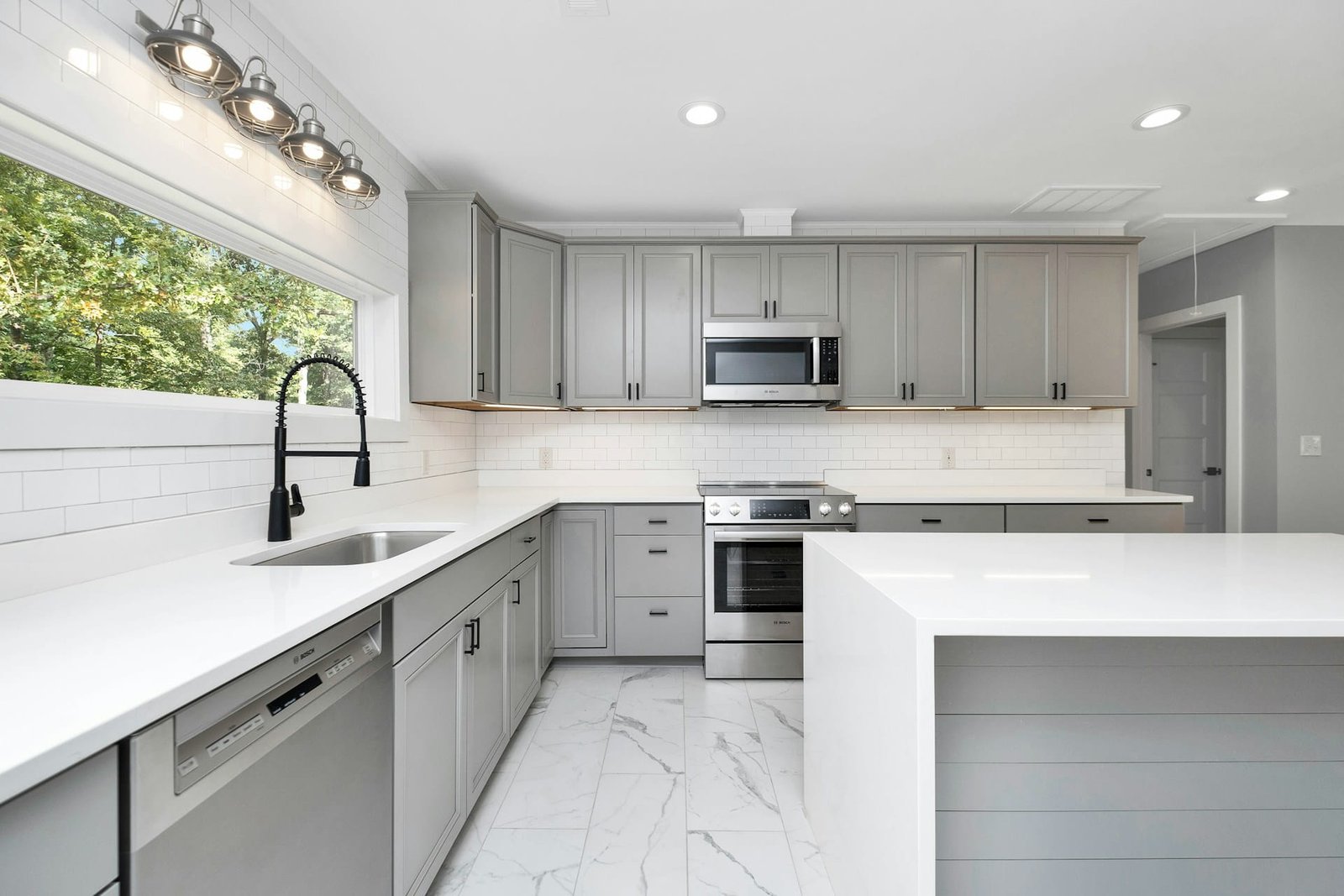
Updated November 1, 2026 · Prices checked November 2026
Quick answer: Quartz is engineered stone: crushed quartz bound with resin, made in a factory. Quartzite is natural metamorphic rock that started as sandstone. Quartz needs no sealing and costs a little less. Quartzite handles heat and sun better but needs sealing about once a year. Pick quartz for easy care, quartzite for real stone.
Quartz vs quartzite is one of the most confusing choices in a kitchen, because the names sound alike and some slabs look alike. This guide compares them on price, hardness, heat, stains, sun and upkeep, adds up 10 years of ownership, and shows the simple tests the stone industry uses to spot a fake quartzite before you pay for it.

What is the difference between quartz and quartzite?
Quartz countertops are made in a factory. Quartzite countertops are cut from a quarry. That one fact explains almost every other difference in this guide.
Quartz vs quartzite in geology
In geology, quartz is a mineral and quartzite is a rock made almost entirely of it. Natural quartz crystals are the raw material for both counters. Engineered quartz grinds them up and binds them with resin; quartzite fuses them through heat and pressure deep underground. So natural quartz vs quartzite is a mineral vs a rock, while engineered quartz vs quartzite is a factory slab vs a quarried one.
How quartz is made
Quartz is engineered stone. Marble Systems describes the process: manufacturers mix crushed quartz dust and chips with resins and pigments, then press and cure the mix into slabs. MSI says quartz countertops typically contain 93% to 95% quartz crystals, with resin, pigments and other minerals making up the rest. Bob Vila gives a wider 90% to 94% quartz and 6% to 10% resin and pigment.
Brands such as Caesarstone, Silestone and Cambria all sell this type of surface. Because the slab is made to a recipe, color and pattern stay consistent from slab to slab.
How quartzite forms
Quartzite is natural stone. Marble Systems calls it a metamorphic rock that “starts its life as sandstone.” Heat and pressure fuse the sand grains into a dense rock that Bob Vila puts at 90% to 99% quartz grains. Each slab is quarried, cut and polished, so no 2 slabs match exactly.
That natural origin cuts both ways. You get one-of-a-kind veining. You also get variation: Marble Systems notes that porosity changes “depending on the specific block it was cut from.” And because the name “quartzite” sells, softer stones sometimes get the label too (more on that below).
Quartz vs quartzite countertops: side-by-side comparison
Quartz wins on upkeep and consistency. Quartzite wins on heat, sun and natural character. Price is close, with quartzite usually a bit higher.
| Factor | Quartz (engineered stone) | Quartzite (natural stone) |
|---|---|---|
| Price per sq ft | $50 to $200+ (Fixr, January 2026) | $60 to $200 (Fixr, January 2026); $80 to $210 (Fixr quartzite guide) |
| Hardness (Mohs) | 7 (Bob Vila) | 7 to 8 (Bob Vila) |
| Heat | Resin can scorch; use trivets (Caesarstone) | More heat resistant than quartz (Fixr) |
| Stains and sealing | Nonporous; no sealing | Porosity varies by slab; seal about once a year |
| UV and outdoor use | Avoid strong direct sun (MSI); outdoor-rated lines exist | Handles direct sun (MSI) |
| Look | Consistent color; many solid and veined designs | Unique veining; each slab differs |
| Maintenance | Mild soap and water or a pH-neutral cleaner (Caesarstone) | Wipe spills quickly; reseal yearly |
| Fabrication | Faster to cut and edge | Slower to cut, polish and edge (Marble Systems) |
Sources: Fixr kitchen countertop cost guide (updated January 2026), Fixr quartzite guide (updated August 2025), Bob Vila, Caesarstone care guide, MSI and Marble Systems. Each row is explained in the sections below.
Durability: hardness and scratches
Both resist scratches well. Bob Vila rates quartzite 7 to 8 on the Mohs scale and quartz 7, and says quartzite is “more scratch- and acid-resistant.” Fixr calls both “relatively scratch-resistant.”
Not every source agrees. IGS Countertops lists quartzite at 7 to 9 and quartz at 4, while the same page also claims quartz is harder. The 7 rating belongs to the quartz mineral; the finished slab also contains resin, which is softer. Treat any single Mohs number for engineered quartz with care, and use a cutting board on both.
Heat resistance
Quartzite takes heat better. Fixr says “quartzite is more resistant to heat,” though both resist a hot pan set down briefly. The weak point in quartz is the resin. Bob Vila says it melts at around 300°F, and Marble Systems warns a scorch can leave “a permanent, cloudy white or yellow burn mark.” Caesarstone tells owners to always put hot cookware on a trivet or hot pad.
Stains, porosity and sealing
Quartz needs no sealing. Quartzite does. Caesarstone calls its surfaces “nonporous,” and Fixr’s quartz guide says you “don’t need to worry much about countertop resealing costs.”
For quartzite, Fixr recommends a silicone-based impregnating sealer “about once a year.” Bob Vila also says to seal before installation and every year after, using a natural stone sealer that costs $10 to $30 at home centers. The sealer soaks in for 10 to 15 minutes and cures for 24 to 72 hours, so plan a day without heavy use.
UV and outdoor kitchens
Quartzite is the safer pick in sun. MSI says quartzite can “handle harsh temperatures and direct sun without issue,” while quartz stays stable as long as it is not exposed to “strong, direct sunlight.” Fixr’s guide on the best countertop materials (January 2025) does not mention UV, so MSI is the main source here.
There is a quartz option for outdoors. Caesarstone announced an Outdoor Collection in a May 2020 post, “tested to withstand UV rays,” with a 10-year warranty. If a quartz counter will sit by a sunny window or outside, ask the brand whether that color is rated for it.
Look and slab size
Quartz offers more colors and repeatable patterns. Quartzite offers natural veining that differs from slab to slab. Bob Vila lists standard quartz slabs of 120 by 55 inches, 2 or 3 centimeters thick, and says quartzite slabs have no standard size. Quartz weighs about 20 to 25 pounds per square foot and quartzite about 20. Because quartzite slabs vary, pick your actual slab at the stone yard rather than from a small sample.
Quartz vs quartzite price: which costs more?
Quartzite usually costs a little more. The ranges overlap a lot, so a premium quartz can cost more than a common quartzite. The table shows the cost of quartz vs quartzite from each source we checked.
| Source (date) | Quartz, per sq ft | Quartzite, per sq ft |
|---|---|---|
| Fixr kitchen countertop cost guide (January 2026) | $50 to $200+ (average $88) | $60 to $200 |
| Fixr quartz guide (January 2026) and quartzite guide (August 2025) | $50 to $200+ | $80 to $210 |
| Bob Vila countertop cost guide (May 2025) | $65 to $270 | $95 to $275 |
| Bob Vila quartz vs quartzite (October 2020) | $60 to $150 | $70 to $200 |
Sources: Fixr’s countertop cost guide, quartz guide and quartzite guide; Bob Vila’s countertop cost guide and quartz vs quartzite article. Bob Vila’s figures are per installed square foot; Fixr’s countertop cost table does not say whether its figures include installation. The 2020 figures are the oldest here.
Source: Fixr kitchen countertop cost guide (January 2026), Fixr quartzite guide (August 2025), Bob Vila countertop cost guide (May 2025). Full figures in the table above.
Why does quartzite cost more? Fixr says it “needs to be quarried, cut, and polished,” and Marble Systems adds that a quartzite slab “takes much longer to cut, polish, and edge” than resin-bound quartz. Harder stone means more shop time.
Even Fixr is not fully consistent. Its quartzite page lists quartz at $40 to $100 per square foot, below its own quartz guide. Use the ranges for planning and get at least 2 quotes on the same slab and edge.
What do quartz and quartzite cost over 10 years?
Over 10 years, quartzite costs a few hundred dollars more than its install price in sealer alone. The install price is still the number that matters most.
The table uses Fixr’s 35 square foot typical kitchen and its January 2026 per-square-foot ranges, the same basis as our guide to the best kitchen countertops. Sealing uses Bob Vila’s yearly schedule and $10 to $30 bottle price, assuming 1 bottle per year and that you do it yourself.
| Cost item, 35 sq ft | Quartz | Quartzite |
|---|---|---|
| Countertop (Fixr January 2026 range) | $1,750 to $7,000 | $2,100 to $7,000 |
| Sealing, 10 years (10 × $10 to $30, DIY) | $0 | $100 to $300 |
| Estimated 10-year total | $1,750 to $7,000 | $2,200 to $7,300 |
| Fixr typical project average | $3,500 (35 sq ft) | $4,200 (30 sq ft) |
Our math: Fixr’s per-square-foot ranges × 35, plus 10 years of sealer. Averages come from Fixr’s quartz guide ($3,500 national average for 35 sq ft) and quartzite guide ($4,200 for about 30 sq ft).
Bob Vila’s 2025 cost guide advises sealing quartzite every 6 to 12 months; at twice a year, 10 years of sealer would cost $200 to $600. A pro sealing visit costs more than a bottle; we did not find a current published price we could verify, so ask your fabricator.
What the table leaves out: repairs. A resin scorch on quartz cannot be buffed out, per Marble Systems, and a stain on unsealed quartzite can be hard to lift. Both are avoidable with trivets and yearly sealing. On lifespan, Fixr says both can “theoretically, last for 100 years or more” with proper care. For where countertops fit in the whole budget, see the kitchen remodel cost guide.
How do you tell real quartzite from marble or dolomite?
Real quartzite scratches glass and does not etch with lemon juice or vinegar. Marble and dolomite fail one or both tests. These are the checks the Natural Stone Institute’s consumer site recommends.
The problem is labeling. In “How to Be Your Own Stone Sleuth” (February 2020), Karin Kirk writes for Use Natural Stone, the Natural Stone Institute’s campaign site: “There is really no such thing as soft quartzite, and in most cases that term means the stone is marble.” The same article notes that dolomite etches too, only more slowly. These stones can be beautiful counters, but they need marble-style care.
| Test | How to do it | True quartzite | Marble or dolomite |
|---|---|---|---|
| Glass scratch | Drag a sharp edge of the sample firmly across a glass tile | Bites in and scratches the glass | Glides and only “draws” on the glass; no scratch you can feel |
| Metal tool | Try to scratch the sample with a knife or steel tool | Not significantly scratched | Scratches |
| Acid (etch) | Leave drops of lemon juice or vinegar for 5 to 10 minutes, wipe, view at a low angle | No dull spot | Dull etch mark; dolomite etches more slowly |
Source: Use Natural Stone (Natural Stone Institute). The article notes granite, gneiss, sandstone and quartzite “will all scratch glass,” while marble, dolomitic marble, limestone, travertine, onyx, soapstone and serpentine will not.
Practical tips at the showroom:
- Ask for an offcut or sample from the same slab or lot, and get permission before testing any slab you do not own.
- Feel the mark on the glass. A real scratch can be felt, and you can hear the stone bite in; a softer stone only “draws” on the surface.
- Ask the yard what the stone is geologically, not only its trade name. Names like “soft quartzite” are a warning sign.
- If it fails, it can still be a good counter. Price and care it as marble.
Taj Mahal quartzite vs quartz look-alikes
Taj Mahal is one of the best-known quartzite names, and quartz brands now copy its creamy veining. MSI (March 2026) calls Taj Mahal Quartzite “a natural metamorphic rock” and says its density makes it “resistant to scratching and etching.” Its quartz version, MarfiTaj from Q Quartz, has a “non-porous surface that never needs sealing” and a more uniform look.
So the Taj Mahal quartz vs quartzite choice is the same trade-off as the rest of this guide: natural variation and heat tolerance against zero sealing. If a slab is sold as Taj Mahal quartzite, the glass and acid tests above still apply.
Is quartzite better than quartz?
Neither is better for everyone. Quartzite is tougher against heat and sun; quartz is easier to live with. Match the material to how you cook and how much care you will give it.
Quartz vs quartzite pros and cons
| Material | Pros | Cons |
|---|---|---|
| Quartz | No sealing; nonporous; consistent color; lower starting price | Resin can scorch at high heat; standard colors not meant for strong direct sun |
| Quartzite | More heat resistant; handles direct sun; unique natural veining; high scratch resistance | Needs sealing about once a year; porosity varies by slab; slower to fabricate; risk of mislabeled marble |
Pros and cons are drawn from Fixr, Bob Vila, MSI, Marble Systems and Caesarstone, as cited above.
| Choose quartz if you… | Choose quartzite if you… |
|---|---|
| Want zero sealing and simple soap-and-water care | Want real stone with one-of-a-kind veining |
| Want slabs that match, or a solid color | Often set hot pans down and want more heat tolerance |
| Are on a tighter budget (lower starting price) | Have a sunny counter or an outdoor kitchen |
| Have kids or a busy kitchen where spills sit | Will reseal about once a year |
| Want to choose from a sample without visiting a stone yard | Can visit the stone yard to pick and test your slab |
Where I would put my money between the two
For a busy family kitchen, I would choose quartz. The sources agree it needs no sealing, and its main weakness, heat, is solved by a trivet.
I would only pick quartzite if I loved a specific slab, could test a sample from it, and was happy to reseal once a year. The price gap is small next to the risk of paying quartzite money for a mislabeled marble, so the glass and acid tests would come first.
Both are part of a bigger shift toward veined stone. Our 2026 kitchen renovation trends post covers how designers rank quartzite right now.
Granite vs quartz vs quartzite: how do all 3 compare?
Granite has the lowest starting price of the 3 and handles heat well. Quartz is the easiest to care for. Quartzite costs the most but pairs natural stone with the veined look many buyers want.
| Factor | Quartz | Granite | Quartzite |
|---|---|---|---|
| What it is | Engineered stone | Natural stone | Natural metamorphic stone |
| Price per sq ft (Fixr) | $50 to $200+ | $40 to $150 | $60 to $200 |
| Price per sq ft (Bob Vila, May 2025) | $65 to $270 | $50 to $340 | $95 to $275 |
| Heat | More likely to burn than granite (Fixr) | Will not burn or discolor under a hot pan (Fixr) | More heat resistant than quartz (Fixr) |
| Sunlight | Avoid strong direct sun (MSI) | Light colors can discolor in sunlight (Fixr) | Handles direct sun (MSI) |
| Sealing | None | Fixr calls it non-porous; Bob Vila (May 2025) says seal yearly | Every 6 to 12 months (Bob Vila) or about once a year (Fixr) |
| Glass scratch test | Not applicable | Scratches glass (NSI) | Scratches glass (NSI) |
| Silica content | Over 90% (CDC) | Under 45% (CDC) | 90% to 99% quartz grains (Bob Vila) |
Sources: Fixr’s quartz guide (granite and quartz prices) and countertop cost guide (quartzite price), Fixr’s best countertops guide (heat and sun), Bob Vila, MSI, Use Natural Stone and the CDC. Fixr’s best countertops guide gives a wider granite range of $40 to $200.
On granite vs quartzite alone: both are hard natural stones that pass the glass test, and Fixr says both can last 100 years or more with care. Granite usually costs less per square foot; quartzite is chosen mostly for its marble-like veining. Granite is most often weighed against quartz, so we cover that matchup, including sealing, in depth in quartz vs granite.
Is cutting quartz or quartzite a silicosis risk?
Yes, for the workers who cut it. Dust from cutting engineered stone has caused severe silicosis among countertop fabricators. The risk comes from cutting and grinding slabs in the shop.
The CDC’s MMWR report (September 2019) says engineered stone has “substantially more silica than does natural stone”: over 90%, compared with under 45% in granite. That report described 18 silicosis cases, including 2 deaths, among stone fabrication workers in 4 states. It recommends tools with water feeds, local exhaust ventilation and respiratory protection.
Public Health Watch reported in July 2023 that California had 77 confirmed silicosis cases among engineered stone fabricators. In a JAMA Internal Medicine study of the first 52 cases, 20 workers had advanced disease at diagnosis, and 10 had died, at a median age of 46.
Quartzite is also mostly quartz (90% to 99%, per Bob Vila), so dust control matters for any stone shop. Ask your fabricator whether they cut with water, use local exhaust ventilation and give workers respirators. Cutting, drilling or grinding stone at home is a job for a pro with proper dust controls, and any sink or cooktop hookups need a licensed plumber or electrician.
Australia went further. Federal and state workplace ministers agreed to ban the manufacturing, supplying, processing and installing of engineered stone from July 1, 2024, Dezeen reported. The ban does not cover removing or repairing existing counters.
Planning a countertop upgrade? Use the kitchen remodel cost guide to see where the counter fits in your budget, browse more materials comparisons, or send a question.
FAQ
Is quartzite better than quartz?
Quartzite is better for heat and sun. Quartz is better for low upkeep, since it never needs sealing. Pick by how you use your kitchen.
Which is more expensive, quartzite vs quartz?
Quartzite usually costs more. Fixr lists quartz at $50 to $200+ and quartzite at $60 to $200 per square foot, with its quartzite guide at $80 to $210.
Does quartzite need to be sealed?
Yes. Fixr recommends sealing about once a year; Bob Vila’s 2025 cost guide says every 6 to 12 months. Quartz does not need sealing.
Can you put a hot pan on quartz?
Use a trivet. Caesarstone asks owners to always use trivets or hot pads. Marble Systems warns the resin in quartz can scorch and leave a permanent mark.
What is soft quartzite?
Usually marble or dolomite sold under a quartzite name. The Natural Stone Institute’s consumer site says there is “really no such thing as soft quartzite.”
Can quartz countertops go outside?
Standard quartz should stay out of strong, direct sun, per MSI. Caesarstone announced a separate Outdoor Collection in 2020, tested to withstand UV, with a 10-year warranty; check whether it is still sold.
| Guide | What it covers |
|---|---|
| Best kitchen countertops | 8 materials compared on price, heat, stains and upkeep |
| Quartz vs granite | The other big countertop matchup |
| Kitchen remodel cost | Full kitchen budget by size, tier and region |
| Kitchen renovation trends 2026 | Quartzite and veined stone as a 2026 trend |
| Materials and comparisons | All material head-to-head guides |
Sources
- Fixr, “Kitchen Countertop Cost,” fixr.com, checked November 2026
- Fixr, “Quartz Countertop Installation Cost,” fixr.com, checked November 2026
- Fixr, “Quartzite Countertops Price,” fixr.com, checked November 2026
- Fixr, “Best Kitchen Countertops,” fixr.com, checked November 2026
- Bob Vila, “Quartz vs Quartzite: 8 Key Differences for Choosing Between Countertop Materials,” bobvila.com, checked November 2026
- Bob Vila, “How Much Do Countertops Cost?,” bobvila.com, checked November 2026
- Use Natural Stone (Natural Stone Institute), “How to Be Your Own Stone Sleuth,” usenaturalstone.org, checked November 2026
- MSI, “Are Quartz And Quartzite The Same?,” msisurfaces.com, checked November 2026
- Marble Systems, “Quartz vs. Quartzite Countertops: Which is Best for Your Home?,” marblesystems.com, checked November 2026
- Caesarstone, “Care and Maintenance,” caesarstoneus.com, checked November 2026
- Caesarstone, “Caesarstone’s New Outdoor Collection,” caesarstoneus.com, checked November 2026
- IGS Countertops, “Quartz vs Quartzite Countertops: What’s the Difference?,” igscountertops.com, checked November 2026
- CDC, “Severe Silicosis in Engineered Stone Fabrication Workers, California, Colorado, Texas, and Washington, 2017–2019,” cdc.gov, checked November 2026
- MSI, “Five Ways To Get The Taj Mahal Look,” msisurfaces.com, checked November 2026
- Public Health Watch, “Silicosis cases mount among countertop fabricators in California,” publichealthwatch.org, checked November 2026
- Dezeen, “Australia bans engineered stone over silicosis risk”, dezeen.com, checked November 2026

Waqar Un Nisa is the founder and writer of FashionCressta. She is an SEO content writer who writes research-based guides on home renovation costs, kitchen and bathroom remodeling, and countertop and material comparisons. Each guide lists the references used.